Wyschaete Sector

3rd to 8th Apr 1916

'The Wytschaete sector ran from the neighbourhood of Spanbroekmolen (in the German lines) thence northwards in an irregular line, crossing Vandamme Hill to the Vierstraat - Wytschaete road, just north of Byron Farm; thence the line bent in a north easterly direction to just south of the eastern extremity of Bois Confluent' (Wyrell. p.118).

All three Bdes were in the line, with the 149th Bde in the centre section from the left flank flank of the 150th Bde to just north of Byron Farm - trenches H3 to L5.

The 4th Bn had a relatively quiet six day tour in the trenches compared to the rest of the Northumberland Bde. Nevertheless, on the 8th the enemy scored a direct hit on a dug out (L.7L) with a heavy shell, killing two men and wounding four. Eight men were also wounded by splinters, although the wounds were slight and could have been avoided, if they had been in a properly constructed trench. The Bn was relieved by the 5th Bn on the 8th and proceeded to Locre, for what they believed was six days rest.

During the afternoon of the 3rd the 50th Divn HQ moved from Hooggraaf to Westoutre, and General Wilkinson assumed command of the new sector at 3pm.

9th to 13th Apr 1916

Unfortunately, the rest period was brought to any early end by heavy enemy artillery activity, which began on the 9th, compounded by bad weather on the 12th and 13th. Casualties in the front line were high and led to the relief of the 5th Bn by the 4th on the night of the 13th.

TRENCHES

14th - 15th Apr 1916

Two quiet days.

18th Apr 1916

There were three heavy, but short artillery barrages from the enemy on the 18th and the 50th Divn artillery retaliated. Fortunately there were no Bn casualties. The Bn was relieved in the trenches by the 5th Bn and proceeded to Bde Reserve. Three Coys were sent to farm billets, but one was left in the support trenches. In response to all leave being cancelled and those on leave being recalled, the latter returned on this day.

19th Apr 1916

As this was the first day out of the trenches, Coys were rested and had the use of the baths at La Clytte.

20th Apr 1916

The 20th was the first anniversary of the Bn arriving in France. The CO inspected the Kemmel defences, prior to one Coy being sent there, in accordance with dispositions to be taken up next week.

21st - 22nd Apr 1916

Nothing of note took place other than the church services held on Good Friday (21st) and the relief of the 5th Bn in the front line trenches on the 22nd.

23rd Apr 1916 St Georges Day.

As the patron saint of the Northumberland Fusiliers was St George, all the fusiliers wore roses.

24th - 25th Apr 1916

Except for a daily artillery barrage by the Germans, this was a relatively quiet tour, lasting only three days. The 4th Bn was relieved by the 13th Bn King’s on the night of the 25th and placed in Bde Reserve for one day and night only.

The 50th Divn tour in the Wytschaete sector was of short duration, for on the 25th General Wilkinson handed command to the GOC 3rd Divn, whose troops had taken over the three subsectors of the front line and the area to the rear. 50th Divn HQ then moved back into Corps Reserve around Fletre. By the end of April all units of the Northumberland Divn were in the Corps rest area.

The Divn returned to the Wyschaete Sector on the 24th of May 1916 and stayed until early August. From here all roads led to the Somme.

[zotpressInTextBib style="harvard1" sort="ASC"]

[zotpressInTextBib style="harvard1" sort="ASC"]

If would like to read the full story of the 4th NF in World War 1, then please select here
Armagh Wood

19th Mar 1916

The Bn moved into the support lines at at H.30.a, Blaue Pourt Farm1 and Armagh Wood2. Except one NCO wounded and Sgt Maj Sharp killed (see burial book) these were three quiet days. On the night of 21st and 22nd the Bn was relieved by the 4th Bn East Yorkshires and moved back to Dickebusch Huts3. This was a difficult relief due to traffic congestion.

Usual refitting, reclothing and Coy parades. On the 23rd Gen Sir Douglas Haig came and inspected the Bn; it was a wet day and he only saw the men in their huts. A concert was held the same night in the YMCA hut, which went off successfully. The 50th Divn relieved the 3rd Divn in a sector running from the Ypres-Comines Canal at 'The Bluff'4 to Trench '34', the 50th Divn front being held once more by two Bdes and extending from the Bluff to Trench 'A.3'.

25th - 27th Mar 1916

On the night of 24th, the Bn went up to the trenches at Mount Sorrel5 , between Hill 606 and Sanctuary Wood7 . The next two days were quiet, however, on the 26th Canadian officers, from the Bn due to relieve the 4th Bn, visited the trenches. On the 27th the Bn was relieved by the 5th Bn and proceeded to close support positions, with the Bn HQ at Square Wood8.

Sanctuary, Square & Armagh Wood - Military Units

17th Division - Comprised of the 50th, 51st and 52nd Bdes

The 50th Bde. Comprised of the 10th Bn - West Yorkshire Regt, 7th Bn - East Yorkshire Regt, 7th Bn - Yorkshire Regt, 6th Bn - Dorsetshire Regt.

The 51st Bde. Comprised of the 7th Bn - Lincolnshire Regt, 7th Bn - Border Regt, 8th Bn - South Staffordshire Regt, 10th Bn - Sherwood Foresters.

The 52nd Bde. Comprised of the 9th Bn - Northumberland Fusiliers, 10th Bn - Lancashire Fusiliers, 9th Bn - Duke of Wellington’s Regt, 12th Bn - Manchester Regt

24th Division - Comprised of the 17th, 72nd and 73rd Infantry Bdes

The 17th Bde. Comprised of the 8th Bn - Buffs, 1st Bn - Royal Fusiliers, 12th Bn - Royal Fusiliers, 3rd Bn - Rifle Brigade.

The 72nd Bde. Comprised of the 8th Bn - Queen’s, 9th Bn - East Surrey Regt, 8th Bn - Queen’s Own and 1st Bn - North Staffordshire Regt.

The 73rd Bde. Comprised of the 9th Bn - Royal Sussex Regt, 7th Bn - Northamptonshire Regt, 13th Bn - Middlesex Regt, 2nd Bn - Leinster Regt.

50th (Northumbrian) Territorial Division - Comprised of the 149th, 150th and 151st Infantry Brigades.

The 149th (Northumbrian) Bde - Comprised of 1/4th, 1/5th, 1/6th and 1/7th Bns - Northumberland Fusiliers.

The 150th (York & Durham) Bde - Comprised of 1/4th Bn - East Yorkshire Regt - , 1/4th & 1/5th Bn - Green Howards and 1/5th Bn - Durham Light Infantry.

The 151st (Durham Light Infantry) Bde - Comprised of 1/5th (Cumberland) Bn - Border Regt, 1/6th, 1/8th and 1/9th Bn - DLI.

(Select link to find out more about this Brigade).

1st Canadian Division - Comprised of the 1st, 2nd and 3rd Canadian Bdes.

The 1st Canadian Bde. Comprised of the 1st, 2nd, 3rd and 4th Bns Canadian Infantry.

The 2nd Canadian Bde. Comprised of the 5th, 7th, 8th and 10th Canadian Infantry.

The 3rd Canadian Bde. Comprised of the 13th, 14th, 15th and 16th Bns Canadian Infantry. return

If would like to read the full story of the 4th NF in World War 1, then please select here 
 

.

Battle of Bellewarde

Summary of events

Monday, 24th May 1915

It was on this day that the battle now known as Bellewarde Wood began. Around 2am the Germans opened with a gas attack between Hooge9 and Turco Farm 10backed up by a very heavy artillery bombardment. The wind was favourable for such an gas attack, so many officers in the front line were on the alert and the Germans lost the element of surprise. Nevertheless, the troops had little time in which to fit and adjust their primitive respirators before the gas cloud enveloped them. The German infantry assault immediately followed the gas, but in only one part of the line near Mouse Trap Farm11 did they succeed in overrunning the British position.

At the time of the attack the 4th Bn was occupying dugouts near the Chateau des Trois Tours, Brielen12. The CO (Col Foster) of the 4th Bn, awakened by the noise, was already dressing when an orderly arrived with orders for the Bn to be ready to move at a moments notice. This was quickly followed by another orderly and another message which requested Col Foster to report to General Hull (OC 10th Bde) at No2 pontoon bridge13. Col Foster, accompanied by his Adjutant (Capt Cruddas), set off across the fields in the direction of the bridge having left orders for Major Gibson to follow on with the battalion immediately.

'We moved off about 5am, there having been no time for breakfast and most of us had to go with our water bottles empty, as the water carts were not up, and the water at the farm near at hand had been condemned' [zotpressInText item="{6C9UZ7VX}"].
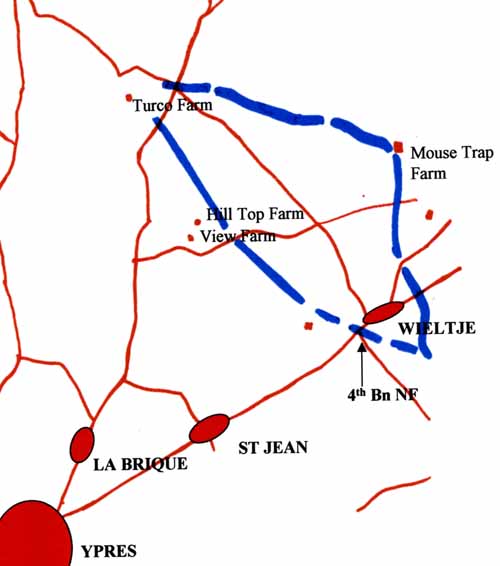
As the Colonel and Capt Cruddas walked north east towards the canal the smell and effects of poison gas grew stronger. By the time they reached 10th Bde HQs14 near the canal, the gas was quite dense even though they were nearly three miles from where the Germans had released it.

General Hull gave instructions for the 4th Bn to be held in reserve on the canal bank and await further orders. It was not long before the Bn came into sight marching along the road from Brielen. The Seaforths, who had been occupying dugouts on the canal bank, moved forward to make space for them and left a very welcome supply of food and water behind. The density of gas in the canal cutting by this time was quite bad, so Col Foster ordered his men to lie just below the top of the bank. They were more exposed to exploding shells, but the CO considered it the lesser of two evils. The heavy shelling continued until approximately 7.30am.

At 10am orders were received to move to the 2nd Divn line west of the St Jean15 - Wieltje16 road. To try and minimise casualties the Bn crossed the fields in single file and entered a deep ditch on one side of the road. Although they all wore their respirators the gas was affecting many in the Bn.

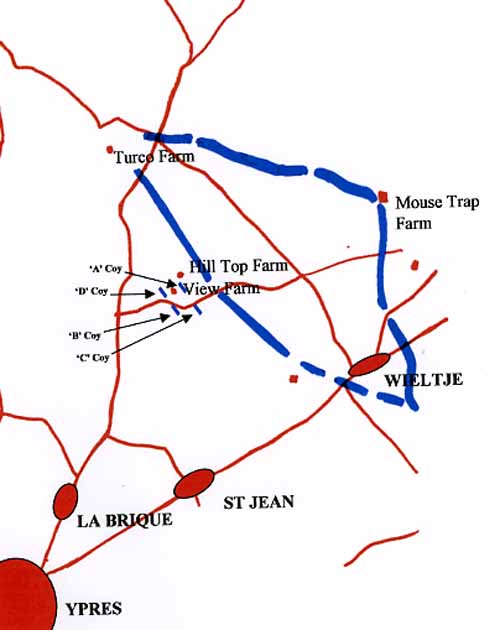
This line was full of troops so the Bn advanced again to the support line at View Farm17. , 'A' & 'D' Coys, under a shower of shells, then recrossed the road and advanced to some trenches near Hill Top Farm18. Capt Robinson, already half blinded by the gas, stumbled into a shell hole and sprained his ankle. Lt Bunbury assumed command of 'A' Coy, but it was not long before he was hit in the foot by a machine gun bullet and had to hand command of the Coy to Lt Turner.

Gas shells were falling around the fusiliers, so at some stage during the afternoon half of 'B' and 'C' Coys were moved out of their trenches and west along the road. Orders were then received to send a Coy to Mouse Trap Farm, a short distance to the north east of the Bn position, to assist the Dublins. The OC of the 1st Bn Warwickshire Regt stopped 'C' Coy stating that the Germans had already driven the Dublins out and captured the farm. 'C' Coy returned during the afternoon with remnants of the 7th Bn and East Lancashires.

At 6pm Col Foster received a service instruction sheet from the OC Warwickshires:

"As soon as it is dusk, please send two Companies into the support lines to prolong the line now held by the Seaforth Highlanders. Also please be in command of the line for the present during my absence, at the telephone in a house which will be shown you on arrival here".

The Bn was then ordered to support a counter-attack by the Somersets and Monmouths set for 10pm. However, this was countermanded because the Germans captured an orderly carrying a message to the Dublin Fusiliers referring to the attack. By this time gas shells were falling heavy and one burst in the trench, killing one man and wounding another. Although the gas was painful to the eyes, no further harm was done. Half of 'B' and 'C' Coys were moved west along the road to avoid the shelling.

In compliance with the Service Instruction issued earlier, B' Company moved forward at dusk to the first line trench to the east of the St Jean-Wieltje road and 200 yards south of Wieltje village, 'A' & half of 'C' Company occupied a trench on the left flank between the road and the Seaforths position . Half of 'D' Coy were placed in support behind them, west of road. The other half of 'C' Coy were placed behind them (map 2). The other half of 'D Coy had been missing since the morning.

At 11.30pm an Orderly arrived with instructions for all available men to be redeployed to the right of the roadway, and for Col Foster to report to General Hull in the village of St Jean. It was a bright moonlit night and the German machine guns were very active, so Col Foster had a lively walk back, guided by the Orderly. Col Poole of the Warwicks was there when he arrived. Col Foster was instructed to dig in to the right of the road and as far east as a small clump of trees. He was also instructed "to stick it at all costs".

Tuesday, 25th May 1915

Col Foster returned to the Bn positions in the support trench to discover that only 'B' Coy were still there. Lts Bradley and Cranage were dispatched to try and locate the missing half of 'D' Coy. Bradley returned to report that they had been commandeered by another Brigadier, attached to the East Lancashires19 and were now filling a gap at Turco Farm. Lt Cranage failed to return because he had been severely wounded shortly after setting off, but fortunately he was spotted by the Bn stretcher bearers and taken to a casualty clearing station.

Trench digging commenced, but with so few men available little progress was made before daybreak when exposed work of this nature had to stop anyway.

The remaining half of 'C' reached 'A' Coy at 2am.

The half of 'D' Coy manning the support trench to the west of the road were hit by half a dozen artillery shells at 2am, some containing gas. A cloud of gas rolled down into the trench but no one was harmed. By 6am this half of 'D' Company were in the support trench east of road. Barricade of support trench on road and house in rear crumped. 'B' & 'C' Companies dug in all night and all day. Shrapnel hit some men from 'B' Company.

The day broke in brilliant sunshine. The fusiliers were awakened by a tremendous boom to the west of Ypres, followed by a sound like an express train drawing near and then passing overhead. Those who peered over the parapet witnessed a 'Grannie' shell score a direct hit on the German occupied Shell Trap Farm.

Flames, red dust and dark masses of debris flung themselves into the sky, followed by volumes of dense black smoke.

About six smaller shells of 9.2 or 6 inch calibre subsequently fell in the same area.

The men were greatly cheered by this episode, feeling a little compensated for the vile gassing of yesterday and the loss of their trench. But the Monmouths celebrated the event a trifle too enthusiastically by lighting fires in front of their dug-outs, against their officers’ orders, of course, and the smoke attracted the enemy’s fire at once (Col A.J Foster).

British artillery shelled the trenches Bellewarde Farm20 all afternoon.

Throughout the 24th of May the 4th Bn, along with several other Bns, were moved in response to orders and counter-orders to try and stem the advance of German troops. Although not directly involved in front line fighting, the constant shelling and exposure to gas resulted in 6 men killed, 27 wounded and 1 missing.

Letter from Pte J Moody (‘A’ Coy) published in the Hexham Courant - 17th of June 1915.

On Sunday night a terrific bombardment started, and early on Monday morning we got the order to leave our dugouts and advance. The Germans were using those gases so we had to use our respirators. I do not know how we could have come on without them, and we passed a lot of unfortunate soldiers making their way back, some of them badly gassed. The effects of the gas are to awful for words. The sweat was teeming down the men’s faces and they were gasping and choking for breath. Thanks to my respirator I was able to go on although I thought my head was going to split. Once, as we advanced towards some trenches a German machine gun started to play on us and Lt Bunbury, one of our officers was wounded. Whenever we crossed a field it was ploughed up by ‘Jack Johnsons’21

They were bursting all over, and how we got so far up with so few casualties is little short of a miracle. When night fell we went forward again and took our place in the firing line. Things were pretty quiet just then, only a few stray bullets flying about, but we had to keep a sharp lookout as the German trenches were only some 500 yards in front of us. We were only in the front line two days and are now back in some reserve trenches not far behind the front line. I expect we will be going further back for a rest shortly and will give you further news then'.

Casualties

Records show that at least 6 fusiliers from the 4th Bn were killed in action or died of wounds during the Battle of Bellewarde. For information on 4th Bn burial and memorial sites for casualties sustained in this battle, select the link.

Bibliography

[zotpress items="WPX27IS4" style="harvard1"]

[zotpress items="HUXKQ9EA" style="harvard1"]

[zotpress items="4R6FADJ9" style="harvard1"]

[zotpress items="6C9UZ7VX" style="harvard1"]

[zotpress items="5MC7CZF6" style="harvard1"]

[zotpress items="APPZ39F9" style="harvard1"]

[zotpress items="BSS9NIJC" style="harvard1"]

If would like to read the full story of the 4th NF in World War 1, then please select here

.

.

Sectors & Battles

The 4th Battalion (Bn) was committed to several British sectors and took part in several assaults on the German front line, but during the Spring of 1918 it was purely rear guard actions in the face of successive German attacks. Select the links below to learn more about the 4th Bn involvement in each of these sectors and battles.

Ypres Salient (Belgium)

21 Apr 1915 - 10 Aug 1916

Battle of St Julien

Select link to find out more

Apr - 4 May 1915

Less than a week after their departure from Newcastle, the Bn are tasked, at very short notice, with a frontal assault on the German lines near the village of St Julien.

24 - 25 May 1915

After a heavy artillery bombardment and gas attack the Germans breach the front line near Turco Farm, to the north east of Ypres. The 4th Bn, at rest near Brielen, are called forward to support the 4th Divn between Turco Farm and the St Jean - Wieltje road.

Sanctuary Wood

11 - 19 Jun 1915

On the 10th of Jun the Northumberland Bde replaced the 7th Bde in the Sanctuary Wood trenches. On the 16th they gave fire support to the 9th Bde during an attack on Bellewarde.

Wulverghem

Select link to find out more

21 Jun - 12 Jul 1915

Tour in a relatively quiet sector below the Messines Ridge.

Armentieres Sector

Select link to find out more

16 Jul - 31st Dec 1915

The 50th (Northumbrian) Divn, including the 4th Bn, occupy trenches to the east of the town of Armentieres.

Hill 60

Select link to find out more

1 Jan - 5 Feb 1916 7 - 14 Mar 1916

The 50th (Northumbrian) Divn man trenches in and around this notorious landmark, the 4th Bn taking its turn in the line.

Sanctuary Wood, Maple Copse

Select link to find out more

9 Feb - 3 Mar 1916

The 50th (Northumbrian) Divn man trenches in and around this notorious landmark, the 4th Bn taking its turn in the line.

Armagh Wood

Select link to find out more

9 - 24 Mar 1916

Square Wood

Select link to find out more

28 - 29 Mar 1916

Wyschaete Sector

Select link to find out more

3 Apr - Aug 1916

The Somme (France)

11 Aug 1916 - 8 Apr 1917

Battle of Flers - Courcelette

Select link to find out more

15 - 22 Sep 1916

First set piece battle involving the 4th Bn. Assault on German trenches on the western edge of the infamous High Wood.

Morval

Select link to find out more

25 - 28 Sep 1916

4th Bn held in reserve by the 50th (Northumbrian) Division, but provided working parties by day and night.

Transloy Ridges

Select link to find out more

1 - 18 Oct 1916

4th Bn held in reserve at Millencourt and spent most of the time training.

12 - 19 Nov 1916

The 4th Bn support attacks made by the 149th Bde on Gird Trench and Hook Sap.

Oct 1916 - Mar 1917

Arras (France)

9 Apr 1917 - 17 Oct 1917

First Battle of the Scarpe

Select link to find out more

9 - 14 Apr 1917

4th Battalion move to the front line south east of the town of Arras

Second Battle of the Scarpe

Select link to find out more

23 - 24 Apr 1917

4th Battalion move to the front line near Wancourt Tower, south east of Arras

Front line near Cherisy

Incomplete

Jul 1917

Passchendaele (Belgium)

18 Oct 1917 - 22 Feb 1918

Second Battle of Passchendaele

Select link to find out more

26 Oct - 10 Nov 1917

Frontal assault on enemy positions by the 4th, 5th and 7th Bns

The Somme (France)

23 Feb 1918 - 3 Apr 1918

Battle of St Quentin

Select link to find out more

21 - 23 Mar 1918

Defensive action by 50th (Northumbrian) Divn in the face of a major German Spring offensive on the Somme

Somme Crossings

Select link to find out more

24 - 25 Mar 1918 Continuing defensive action by 50th (Northumbrian) Divn in the face of a major German Spring offensive on the Somme

Battle of Rosieres

Select link to find out more

26 - 27 Mar 1918 Continuing defensive action by 50th (Northumbrian) Divn in the face of a major German Spring offensive on the Somme

The Lys (France)

4 Apr - 26 Apr 1918

The Battle for Estaires

Select link to find out more

9 - 15 Apr 1918

Defensive actions by 50th (Northumbrian) Divn in the face of the second German Spring offensive launched in the River Lys area. The 4th Bns' role was to help defend the bridges over the River Lys in the small town of Estaires. After 24 hours of fighting the 4th, along with its sister Bns, was forced out of the town by the enemy. In the days that followed the whole Divn, sadly depleted in numbers, continued to fight but steadily withdrew to the northwest, until the enemy advance ran out of steam.

The Aisne (France)

27 Apr 1918 -

The Battle of the Aisne

Select link to find out more

27 May - 6 Jun 1918 (German offensive)

The 4th Bn was decimated during the third and final German Spring offensive, with the majority of the men either killed or captured when their positions were overrun.

2 Jun 1918

Three composite battalions were formed out of all the fit men left in the 50th Division

Hocquincourt, Huppy

5 Jul 1918

All the battalions of the 50th Division are reduced to training cadre strength, with all surplus personnel transferred to the Base. The 50th Divn is the reconstituted with completely different battalions.

Rouxmesnil, Harfleur and Fecamp

15 Aug 1918

Cadre Bn joined the 118th Bde, 39th Divn as a Training Cadre on 16th Aug 1918. Disbanded 10th November 1918